
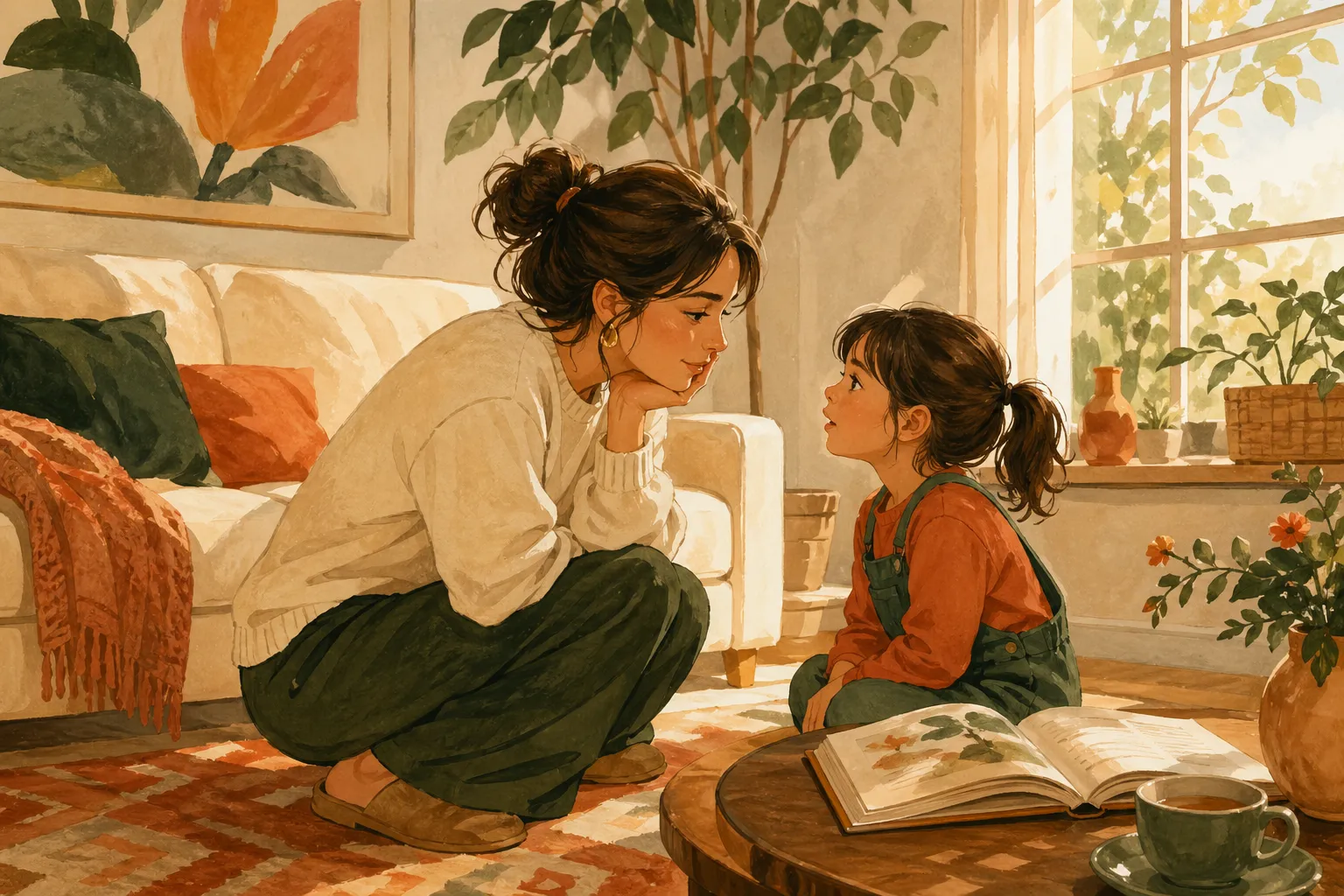
Change One Sentence. Watch Your Child Change.
It's not how much you say — it's how. Harvard's Rolland shows how Rich Talk and the ABC model turn daily chats into tools for raising curious, confident, empathetic kids.
Book Review · Parenting Wisdom
Talking with Your Child
Is an Art
One conversation can light up a child's future.
One question can open a world of possibility.
It was an ordinary Sunday evening.
Rebecca Rolland and her husband had just finished putting their two kids to bed and were sitting in their Boston apartment, planning the week ahead as they usually did. When the bustle finally settled, she turned to her husband and asked: "What did we actually talk to the kids about today?"
Her husband paused. "I don't know… the usual stuff, I guess."
They looked at each other, a little embarrassed. A full, active weekend — trips to the park, meals to cook, homework to check, toys to tidy — and neither could recall a single meaningful conversation.
"We were so busy taking care of our children's lives, we forgot to step inside their minds."
—— Rebecca Rolland, Harvard Lecturer & Speech-Language PathologistThat small moment of recognition became the seed of this book. As a dual faculty member at Harvard Medical School and the Graduate School of Education, and as a mother herself, Rolland spent over a decade researching how we communicate with children — and her conclusion is both humbling and hopeful: the way we talk with our children is quietly shaping who they become.
It's Not About Talking More — It's About Talking Better
Many parents assume that as long as they talk to their children often, development will take care of itself. But Rolland's research reveals that the quality of conversation matters far more than the quantity. She calls truly valuable exchanges Rich Talk — a framework for open, flexible, child-centered communication that goes far beyond daily logistics.
Rolland once observed a group of pre-kindergarteners at a glitter slime-making party. One child had noticeably less material than the others. No adult stepped in. No one said a word.
The children exchanged glances. Then, one by one, each quietly scooped a little of their own slime and passed it over — until everyone had roughly the same amount.
Who taught them to do that? Rolland's answer: the parents and teachers who, over months of daily conversation, had casually asked things like "How do you think he felt?" and "What would you do if that were you?" Those small questions planted seeds of empathy — and those seeds were now blooming, right there in a classroom, without a single adult prompting them.
This is the quiet power of rich talk. It isn't a formal lesson. It's a thousand tiny seeds scattered across the ordinary moments of family life — and they grow into kindness, confidence, and creativity.
The ABCs of Rich Talk
To make rich talk practical for busy parents, Rolland distills it into a simple, memorable framework — the ABC Model — three principles you can run through in your head during any conversation with a child.
Meet your child where they are — in the moment and over time. Follow their mood, their temperament, their pace.
Real conversation is a two-way street. Avoid broadcasting. Invite, listen, respond, then invite again.
Start with what's on your child's mind, not your agenda. Let them lead the direction. You follow.
Story: The After-School Interrogation
Nearly every parent has been there: the moment the front door opens, the questions start firing.
The difference? The first feels like an audit. The child is being checked up on. The second feels like genuine curiosity — and children can always tell the difference.
When children hit adolescence and seem to shut down, Rolland says don't force a sit-down conversation. Research shows that teenagers open up far more during side-by-side activities — in the car, on a walk, while cooking — than they do face-to-face across a table.
That's the A in action: adapting to when and how your child is ready to talk, not demanding they conform to your timing.
What Does Conversation Actually Build? The Seven Pillars
At the heart of the book is Rolland's Seven Pillars framework — seven core qualities that everyday conversation can nurture. Each chapter is devoted to one pillar, weaving together psychological research, clinical observation, and real family stories.
Story: How Curiosity Gets Talked to Death
Rolland shares a memory of walking with her daughter when, out of nowhere, the little girl pointed at the sky and asked:
"Mom, when people die — do they come back as someone else?"
Rolland stopped walking. The question hadn't come from nowhere — it had been building, question by question, from years of fascination with mummies and Halloween picture books. Her daughter had been working up to something big.
Rolland didn't say "We don't really know, honey" and move on. She crouched down and said: "What made you think of that? What do you think?"
What followed was a long, winding, utterly original theory her daughter had been constructing in her head for months. Rolland realized: the best answer to a big question is sometimes another question.
When parents rush to supply the "right answer," children learn that questions are for getting answers — not for exploring the world. Over time, that lesson quietly kills curiosity. Rich talk does the opposite: it treats every question as an invitation to think together.
Building Empathy: The Three E's
Of all seven pillars, Rolland gives particular attention to empathy — the root of healthy relationships and emotional resilience. She offers a dedicated toolkit for growing it through conversation: the Three E's.
Help children find precise words for what they feel. Not just "I'm sad" — but "I feel left out" or "I'm a little jealous."
Guide children to ask: why did that person act that way? What might they have been feeling? Step inside someone else's shoes.
After acting with kindness, reflect together: how did that go? Did things change? What would you do differently next time?
Story: The Grumpy Cashier
Rolland was at the grocery store with her son when the cashier was noticeably cold and abrupt. Her son whispered, "That lady is really rude."
A lot of parents would say: "Just ignore it. Some people are like that." And move on.
Instead, Rolland put the Three E's to work:
Explore: "Why do you think she was like that today? What do you think might have happened to her?"
Her son thought for a moment: "Maybe she's really tired? Or she's having a bad day?"
Expand: "What do you think it feels like to stand on your feet all day and deal with so many people?"
"Probably exhausting… maybe she just wants to go home."
A five-minute conversation at the checkout line quietly planted one of life's most important lessons: every person you meet is carrying a story you can't see.
You Might Be Praising Your Child Wrong
When it comes to building confidence, most parents instinctively reach for praise. But Rolland draws on a wealth of developmental research to make a counterintuitive case: excessive, vague praise can actually undermine a child's self-esteem.
When a child shows you a drawing and you exclaim "You're amazing! You're the best artist ever!" — they know, on some level, that it isn't quite true. Repeated often enough, they start to distrust your judgments, avoid challenges (because failure would shatter the "best ever" image), and become dependent on external validation rather than developing their own internal compass.
Rolland suggests returning the power of evaluation to the child. Swap statements for questions:
- "What's your favorite part of this drawing?"
- "What do you think you did really well?"
- "If you drew it again, what would you change?"
- "What did you figure out today that you didn't know before?"
This is what Rolland calls a growth conversation — one that teaches children to be their own judges, rather than waiting for someone else to tell them they're good enough.
On the subject of mistakes, Rolland also encourages parents to model fallibility openly — share a mistake you made today, talk through how you handled it. Let children see that errors aren't evidence of failure; they're the raw material of learning.
"Children don't need to hear 'You're the best.'
They need to hear 'You were willing to try — and that matters.'"
The Best Classroom Is Playtime
One of the book's most illuminating chapters explores conversation during play. Rolland observes that many well-meaning parents, without realizing it, tend to take over their child's play — correcting how the blocks are stacked, turning the game into a covert lesson, steering the story in a more "sensible" direction.
Parent-led: A child builds a lopsided block tower. Dad says, "That'll fall over — here, let me show you how to balance it." He takes over and rebuilds it correctly.
Rich Talk: Dad says, "Wait — your tower is totally crooked on purpose? What's it for? How do the people inside walk around?"
The second approach turns a "mistake" into a doorway — to imagination, physics, storytelling, and a conversation the child will actually remember. The first just teaches him that his ideas need fixing.
The goal isn't what you play, but whether you're genuinely following your child's thinking — treating play as a space for exploration, not a vehicle for teaching correct answers.
- Ask "And then what?" instead of "Why?" — "Why" can feel like an interrogation. "And then what?" opens the story forward.
- Allow conversations with no conclusion. Not every exchange needs to solve something. Wandering together through an idea has its own value.
- Turn "I don't know" into a gift. Say "I have no idea — let's find out together." Model lifelong curiosity.
Even the Hardest Conversations Have a Way In
Rolland doesn't sidestep the difficult terrain. She walks parents through the scenarios that feel most daunting:
-
Tantrums and emotional meltdowns: Name the emotion first — don't reason through it. "It sounds like you're really frustrated right now" does more to calm a child than "You need to stop that." Understanding comes before logic.
-
Bullying, rejection, and setbacks: Listen first without fixing. Once a child feels truly heard, they become far more open to thinking through solutions together.
-
Race, identity, and social difference: Don't avoid these topics. Research consistently shows that parental silence on sensitive subjects leads children to fill the gap with bias-reinforcing assumptions on their own. An honest, age-appropriate conversation is always better.
-
Death, illness, and the scary unknowns: Acknowledge what you don't know: "None of us knows for sure." Then offer emotional safety — not false certainty. Children can handle more honesty than we tend to give them credit for.
Running through every difficult chapter is a single, liberating reassurance from Rolland: you don't need to be a perfect parent. You just need to be a present one.
You are allowed to say the wrong thing, to not have the answer, to feel uncertain. None of that undoes a conversation. What children remember — and what shapes them — is simply this: that you showed up, that you listened, that you cared enough to stay in the room.
Start with One Small Change — Today
You might finish this book and feel overwhelmed: "My conversations have been all wrong. Where do I even begin?"
Rolland's answer is gentle and firm: don't try to overhaul everything. Start with one tiny shift.
Rich talk doesn't require perfect conditions, a special time carved out of the day, or any expertise. It happens in the car on the way home from school, in the kitchen doing the dishes, in the five minutes before the light goes out at bedtime.
- Replace "How was your day?" with "What was the best moment today? The hardest?"
- When your child says something, say "And then what?" before offering your own thoughts.
- Share one mistake you made today — and how you dealt with it.
- Next time your child asks a question you can't answer, say "I don't know — let's look it up together."
- During playtime, let your child set the rules. You follow their lead for once.
These changes seem small. Over months and years, they become something extraordinary: a relationship in which your child, when life gets hard, instinctively turns toward home — and when something wonderful happens, you're the first person they want to tell.
"Conversation is the longest-lasting gift
we can give our children."
—— Rebecca Rolland
A Book Every Parent Deserves to Read
Not a manual for perfect parenting — but a guide to finding real connection in the middle of a busy life.
Ready to take your family somewhere extraordinary?
Download Kinmory, open your family album, and ask Kini to take you somewhere you've never been. More is a good place to start.

Scan to Download
Point your camera here
kinmory.ai/download/kinmory